


 Română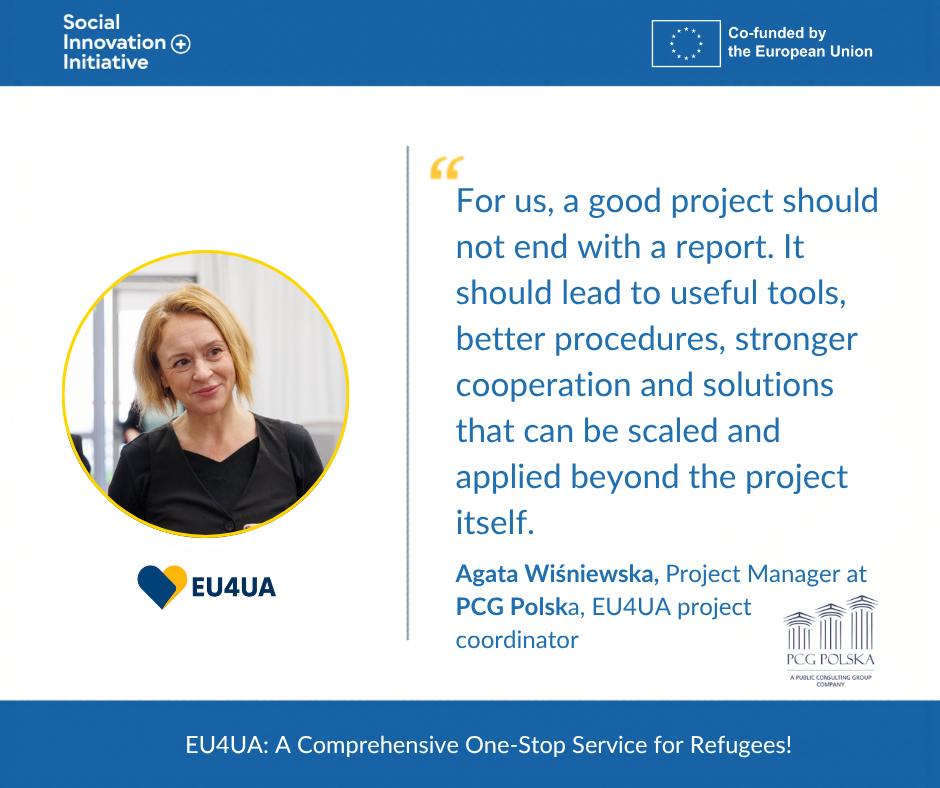
Enterprising for Tomorrow 2026 is organised as part of the EU4UA project’s communication and dissemination activities, creating space for the first project insights to be shared with European stakeholders, policymakers and social economy leaders.
In this context, we invite you to read our interview with Agata Wiśniewska, Project Manager at PCG Polska and Project Manager of EU4UA, about PCG Polska’s mission, its role as coordinator, and the project’s ambition to build practical support systems for Ukrainian families seeking safety.
About PCG Polska
We began the conversation by looking at PCG Polska’s work and the way the organisation brings together analysis, institutional knowledge and practical implementation.
How would you describe PCG Polska’s mission to someone discovering the organisation for the first time?
First of all, it should be mentioned that PCG Polska is part of the global Public Consulting Group, founded in 1986 and headquartered in Boston, Massachusetts. PCG primarily supports public sector organisations in health, education and human services, helping them make measurable improvements to their performance, processes and services.
PCG Polska brings this mission into the Polish and European context. We support public institutions and social-sector partners in designing and implementing practical solutions that improve how services work in real life.
We work in areas such as education, social services, public policy, digital solutions and institutional development. Our role is often to connect analysis with practice: we diagnose needs, design tools and recommendations, support implementation, and help institutions use project results in a sustainable way.
For us, a good project should not end with a report. It should lead to useful tools, better procedures, stronger cooperation and solutions that can be scaled and applied beyond the project itself.
PCG Polska is part of Public Consulting Group, with international experience and a strong presence in Poland. How does this combination of local understanding and international expertise help in projects such as EU4UA?
This combination is a clear added value for partners working with us. On the one hand, PCG Polska has a strong understanding of the Polish institutional and social context. We work with public institutions, education providers, local authorities, NGOs and social-sector organisations, so we are close to the real challenges faced by institutions and communities.
This is particularly important in projects such as EU4UA, where solutions need to be both practical and realistic. Through our experience in social innovation programmes, including Generator Innowacji (www.sieciwsparcia.pl – a national hub for innovations), we are in direct contact with different types of NGOs, practitioners and innovative solutions created for people facing difficult circumstances. This gives us access to diverse expertise and helps us understand how ideas can be tested, improved and transferred into practice.
Our research background also allows us to cooperate effectively with academic institutions and experts. At the same time, PCG’s development in Poland, including its connection with LIBRUS and PCG Academia, strengthens our capacity in digital and analytical solutions for the education sector, from early childhood education to higher education.
On the other hand, as part of the wider Public Consulting Group, we also benefit from international experience, contacts and a broader perspective.
Our headquarters are located in the United States, which may also be an added value in the context of Horizon Europe projects, especially under the Health pillar, where US-based organisations may be eligible partners.
More broadly, PCG’s international presence helps us avoid looking at challenges only from one national point of view. In EU4UA, this is important because refugee integration requires solutions that are locally grounded, but also transferable to other countries and institutional contexts.
PCG works with public institutions, local authorities, schools, universities and social organisations. Why is this cross-sector experience important in European projects focused on inclusion?
This cross-sector experience is important because inclusion is never the responsibility of one institution or one sector only. People in difficult situations often need support in several areas at the same time: education, employment, social services, legal information, digital access, community integration or psychological support.
Because PCG Polska works with different types of institutions and organisations, we understand how these systems operate in practice and where coordination problems may appear. This helps us design solutions that are realistic, useful and easier to implement.
In projects such as EU4UA, this perspective is especially relevant. Refugee support requires cooperation between public administration, NGOs, local authorities, education providers and service organisations. Our role is to help connect these perspectives and turn them into practical models, tools and recommendations.
What should partners expect when they work with PCG Polska in a European project?
Partners should expect strong coordination, clear communication and a practical approach.
PCG Polska brings experience in managing complex projects, working with different stakeholders and translating ideas into concrete resources. We focus not only on formal project delivery, but also on making sure that the results are useful for institutions, practitioners and the people they support.
Partners can also expect openness and cooperation. We try to make everyone’s role clear, support partners in contributing their expertise and keep the consortium focused on common goals. For us, good project management means structure, responsibility and flexibility when challenges appear.
What makes European partnerships work
European projects depend on more than a good idea. They need people, structure and trust. Agata Wiśniewska explains what makes coordination work across countries, systems and professional cultures.
What makes coordination successful in a consortium that includes partners from different countries, systems and professional cultures?
Successful coordination is based on clear communication, trust, shared responsibility and motivation.
The coordinator needs to create a common working framework for the international consortium. This means clear roles, realistic deadlines, regular communication and transparent decision-making.
At the same time, coordination is also about people. In my view, one of the toughest tasks of a good coordinator is to keep people motivated to do the project as well as they can until the end. This requires not only structure and control, but also listening, encouraging partners, recognising their contribution and helping solve problems early.
In my experience, the best coordination combines structure with flexibility: everyone knows what needs to be done, but there is also space to adapt when the project reality requires it.
From PCG’s experience, what are the most important ingredients of a strong European partnership?
A strong European partnership needs clear roles, complementary expertise and real commitment from all partners.
Each partner should bring specific value to the consortium, for example research expertise, practical experience, access to participants, public-sector knowledge, digital capacity or experience in communication, dissemination and policy work. The partnership is strongest when these different competences genuinely complement each other.
Trust is also essential. Partners need to communicate openly, react early when something needs adjustment and take responsibility for their part of the work. In European projects, success depends not only on a good idea, but also on the quality of cooperation during implementation.
Why EU4UA matters now
The conversation then turned to EU4UA and to the practical question at the heart of the project: How can institutions move from fragmented support to clearer, more coordinated pathways for Ukrainian families seeking safety?
EU4UA focuses on supporting the integration of Ukrainian refugees in local communities and labour markets in Poland, Romania and across the EU. Why is this project needed now?
EU4UA is needed because support for Ukrainian refugees has moved beyond the first emergency phase.
Many Ukrainian families are no longer looking only for immediate protection, but for stable conditions to rebuild their lives: access to work, education, housing, health and psychosocial support, language learning and community participation.
At the same time, public institutions, NGOs and local services are under pressure and often work with limited coordination. The project responds to this moment by helping institutions move from short-term crisis reaction to more structured, long-term integration support.
The project aims to create, test and share a comprehensive and scalable support model. What gap does this model try to address?
The model addresses the fragmentation of support.
In many local contexts, refugees have to move between many institutions and organisations to receive help, often repeating their story several times and facing unclear pathways. Services may exist, but they are not always connected.
EU4UA tries to close this gap by developing a one-stop-shop approach: a coordinated model where needs assessment, referral, case management, labour market guidance, psychosocial support and community-based services are better integrated.
The aim is not to replace existing institutions, but to help them work together in a more coherent and user-friendly way.
How can EU4UA help public institutions, NGOs, local authorities and social organisations offer better support to Ukrainian families seeking safety?
EU4UA can help by giving institutions and organisations practical tools, not only general recommendations.
This includes a Blueprint, assessment tools, referral mechanisms, examples of integrated services, and guidance on how to organise cooperation between different actors.
For public institutions, it can support better coordination and planning. For NGOs and social organisations, it can provide a common framework for working with public services. For local authorities, it can show how to build a more predictable support pathway for refugees.
In practice, this means less duplication, clearer responsibilities and more personalised support for Ukrainian families.
The project aims to create solutions that can be adapted in different national and local contexts. What makes a support model truly scalable across Europe?
A support model is truly scalable when it is not too rigid. It must have a clear structure, but also allow adaptation to different legal systems, institutional capacities, funding mechanisms and local community resources.
In the case of EU4UA, scalability means that the core logic of the model, integrated support, needs assessment, referral, case management and cooperation between sectors, can be transferred, while the concrete implementation can be adjusted locally.
A scalable model also needs to be evidence-based, tested with practitioners and refugees, understandable for decision-makers, and realistic for organisations that may have different levels of capacity.
What does PCG hope the project will change in the way institutions think about refugee integration?
PCG hopes EU4UA will help institutions see refugee integration not as a separate or temporary issue, but as part of broader public service planning.
Integration should not depend only on emergency projects or individual commitment from front-line workers. It should be organised as a coordinated process involving public institutions, NGOs, employers, education providers and local communities.
We also hope the project will strengthen a more person-centred approach: starting from the real needs of refugees and then building services around them, instead of expecting people to navigate a fragmented system on their own.
If you had to explain the long-term value of EU4UA to a policymaker, what would you say?
I would say that EU4UA is valuable because it turns the experience of supporting Ukrainian refugees into a practical model that can improve integration systems more broadly.
It does not only describe the problem. It proposes tools, procedures and cooperation mechanisms that can be tested, improved and reused.
In the long term, this can help public institutions design more coordinated, efficient and humane support systems, not only for Ukrainian refugees, but also for other groups experiencing displacement, crisis or difficult life situations.
Its value lies in connecting policy, practice and local implementation in one coherent framework.
Looking beyond EU4UA, PCG Polska is interested in partnerships that can take social innovation further, from project design to practical solutions that can be tested, improved and used in real life.
PCG Polska would like to partner with organisations that are committed to scaling and further developing social innovations beyond their initial project scope. We are particularly interested in research and innovation projects that can generate practical value and be translated into real solutions for institutions, communities and individuals.
At the heart of PCG’s mission is the idea of developing solutions that matter. This is why we look for partners who are not interested only in technology for its own sake, but in solutions that create measurable social impact and respond to real needs. We value organisations that combine ambition with responsibility, openness to cooperation, and a strong focus on improving people’s lives.
Building systems that are easier to navigate
Through EU4UA, PCG Polska and its partners are working to turn the experience of supporting Ukrainian refugees into a practical model that can help institutions cooperate better, reduce fragmentation and build support systems that are easier to navigate.
The project brings together research, local practice and European cooperation to create a blueprint that can be adapted and used in different contexts across Europe.
_______
The project EU4UA: A Comprehensive One-Stop Service for Refugees! is implemented by PCG Polska (coordinator) in partnership with FISE, ADV Romania, Bethany Social Services Foundation, HumanDoc Foundation, Lietuvos socialinio verslo asociacija (LiSVA), FAEDEI, ENSIE and Diesis Network.
The project is funded by the European Union under the ESF+ Social Innovation+ (SI+) initiative. The views and opinions expressed are those of the authors and do not necessarily reflect those of the European Union or the European Social Fund Agency. Neither the European Union nor the granting authority can be held responsible for them.